


ABA in Home Therapy Near Me
Table of Contents
Understanding ABA In-Home Therapy Near Me
Imagine a family in Charlotte, North Carolina, searching for reliable ABA in-home therapy near me to support their child with Autism Spectrum Disorder. The daily challenges of travel and scheduling can feel overwhelming, but options like those from Little Achievers ABA make a difference by bringing personalized interventions right to the doorstep.
Applied Behavior Analysis, or ABA, uses evidence-based techniques to teach skills and reduce challenging behaviors in children with autism. In home ABA therapy adapts these principles to the natural environment, promoting better skill generalization for daily routines. Little Achievers ABA delivers home based ABA therapy across North Carolina, including Charlotte and Durham, Utah, and Colorado, with dedicated local teams led by experts like Board Certified Behavior Analyst Constance Brown.
Key benefits include:
- Convenience: Sessions fit family schedules without long commutes, reducing stress.
- Comfort: Therapy in a familiar home setting fosters engagement and consistency.
- Family Involvement: Caregivers receive training to reinforce progress, with over 80% of families reporting improved outcomes through home-based delivery, as noted in Kansas Family Supportive ABA principles.
This guide explores fundamentals, getting started with intake and online referrals, and advanced strategies for home-delivered ABA services. Contact Little Achievers ABA’s central line or use their SMS system for quick scheduling in your state. For specialized options, explore Private ABA Therapy Charlotte NC to begin your journey toward family-centered behavioral intervention at home.
Fundamentals of ABA Therapy at Home
Families across North Carolina, Utah, and Colorado are increasingly seeking accessible support for children with autism spectrum disorder. If you are looking for ABA in-home therapy near me through trusted providers like Little Achievers ABA, understanding the fundamentals can empower your decision-making process. This residential behavioral intervention focuses on building essential skills in a familiar setting, promoting long-term success. At its core, it involves individualized treatment plans developed by Board Certified Behavior Analysts, data-driven progress tracking, and active caregiver involvement to foster positive behavior changes right at home.
The principles of applied behavior analysis therapy form the backbone of these programs. This evidence-based approach breaks down complex behaviors into manageable steps, using systematic techniques to encourage growth. Key principles include:
- Positive reinforcement: Rewarding desired behaviors immediately, such as praising a child for using words during family dinner to strengthen communication skills.
- Prompting: Offering gentle cues or guidance to help children learn new actions, gradually fading support as they gain independence.
- Generalization: Ensuring skills transfer across different situations, like applying social interactions learned at home to school or community outings.
These elements create a structured yet flexible framework, allowing domicile ABA programs to adapt to each child’s unique needs while emphasizing consistency and encouragement.
While ABA therapy can occur in various environments, in-home and clinic-based models offer distinct advantages that impact family dynamics and outcomes. In-home delivery integrates therapy into daily routines, enhancing relevance, whereas clinic settings provide specialized resources but may feel less personal. The following table highlights key differences to help families in served states evaluate options.
| Aspect | In-Home ABA Therapy | Clinic-Based ABA Therapy |
|---|---|---|
| Environment | Natural home setting for skill generalization | Structured clinical environment; Neutral space away from home distractions |
| Flexibility | Custom scheduling around family routines | Fixed clinic hours; Limited adaptation to daily life |
| Cost Factors | Potential travel savings; insurance-dependent | Facility fees may apply; Higher overhead costs passed to families |
Data from Heartwise Support underscores these contrasts, noting that in-home therapy often leads to higher family satisfaction due to its convenience. For many households, the in-home model proves ideal, promoting seamless integration and reducing logistical barriers while maintaining professional oversight from Little Achievers ABA teams.
These comparisons reveal how environment influences therapy’s effectiveness, particularly for busy families balancing work and school. In-home options minimize disruptions, allowing children to practice skills amid everyday activities like mealtimes or playtime. This natural context not only boosts engagement but also equips parents with tools to reinforce progress independently. Transitioning from clinic to home-based care can feel daunting, yet the personalized support from local providers eases this shift, ensuring sustained development without added stress.
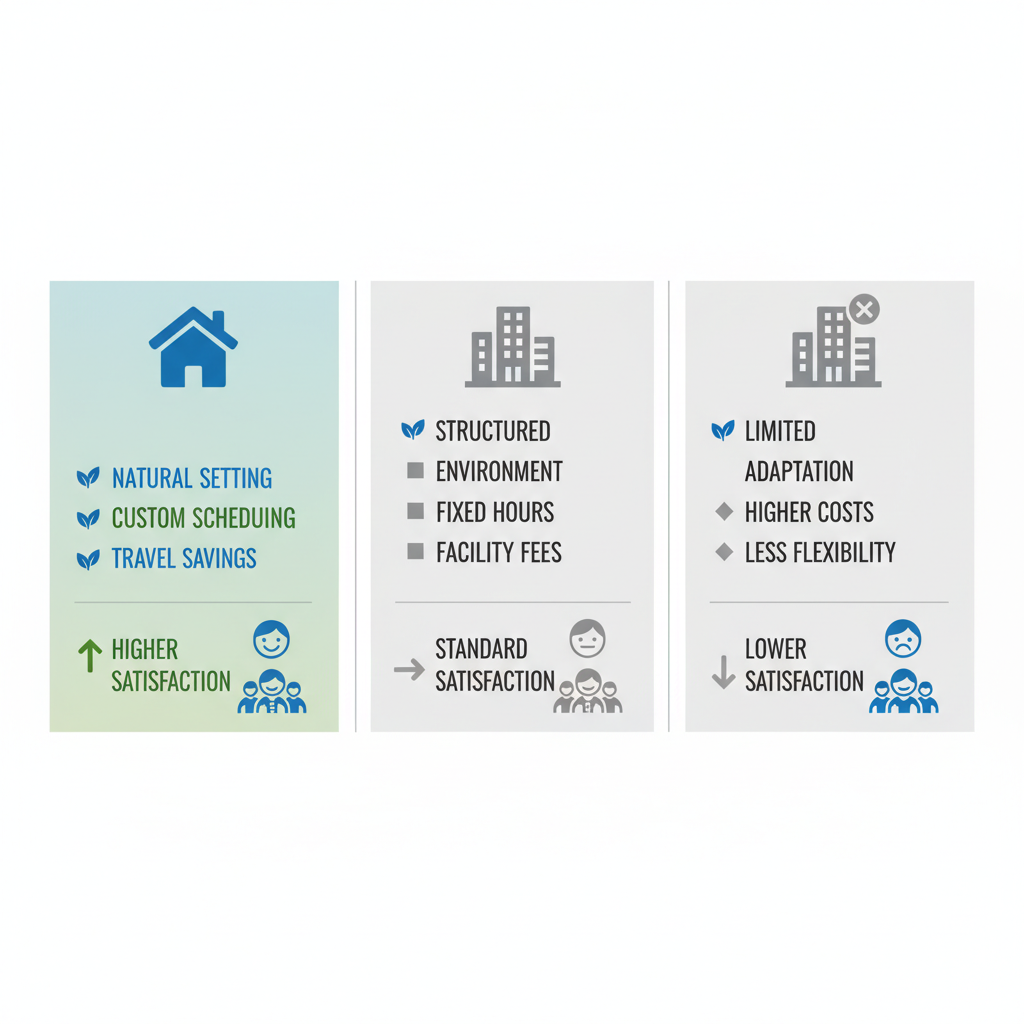
Visual comparison of in-home vs. clinic-based ABA therapy options
In-home ABA therapy sessions typically follow a structured yet adaptable format designed for one-on-one interaction in the child’s natural surroundings. A Board Certified Behavior Analyst conducts an initial functional behavior assessment to identify strengths and challenges, crafting a tailored plan with specific goals. Sessions, often 2-3 hours several times weekly, incorporate natural environment teaching, where therapists embed lessons into routine activities like dressing or sharing toys. This approach, distinct from rigid clinic protocols, promotes real-world application and quicker adaptation.
Home based ABA therapy places a strong emphasis on family involvement, empowering caregivers through hands-on training. Parents learn techniques like prompting and reinforcement to support sessions between professional visits, extending the therapy’s reach. This collaboration, a hallmark of Little Achievers ABA services in North Carolina counties or Utah communities, builds confidence and consistency.
Evidence confirms the effectiveness of home based ABA therapy for autism spectrum disorders. Studies, including insights from Heartwise Support, show in-home models yield 25% faster skill acquisition in natural settings compared to clinic-based ones. Little Achievers ABA’s internal metrics further support this, with families reporting improved communication and independence after consistent implementation. For children in Colorado or beyond, these outcomes highlight ABA’s role in fostering meaningful progress, making it a cornerstone for early intervention and long-term behavioral health.
Exploring In-Depth ABA Strategies for Home
Families seeking ABA in-home therapy near me in North Carolina, Utah, and Colorado can benefit from tailored approaches that integrate seamlessly into daily life. Little Achievers ABA specializes in these domestic ABA methodologies, emphasizing individualized strategies to foster communication, social skills, and independence for children with autism.
Developing Individualized Treatment Plans
Creating customized ABA plans begins with comprehensive functional behavior assessments conducted in the natural home environment. Therapists observe interactions during play and routines to identify strengths and challenges, ensuring the process aligns with family dynamics. This step, informed by evidence-based practices, typically spans 60 words in detailed evaluation.
Once assessments are complete, setting specific, measurable goals follows. For instance, objectives might target improving verbal communication through structured activities or enhancing social engagement during family meals. Little Achievers ABA prioritizes goals that promote long-term independence, such as reducing reliance on prompts for daily tasks. Phased prompting, as outlined in the CRI Getting Started Guide, reduces dependency by 40 percent when tailored to in-residence behavioral techniques.
Practical examples illustrate this process effectively. In one case, a toddler in Charlotte received a plan focusing on turn-taking skills using household toys, leading to noticeable gains in peer interactions at home. Learn more about in-home aba therapy charlotte. For in home ABA therapy sessions, therapists collaborate with families to embed goals into routines, like using mealtime for social practice. This approach, spanning about 70 words, ensures relevance and sustainability.
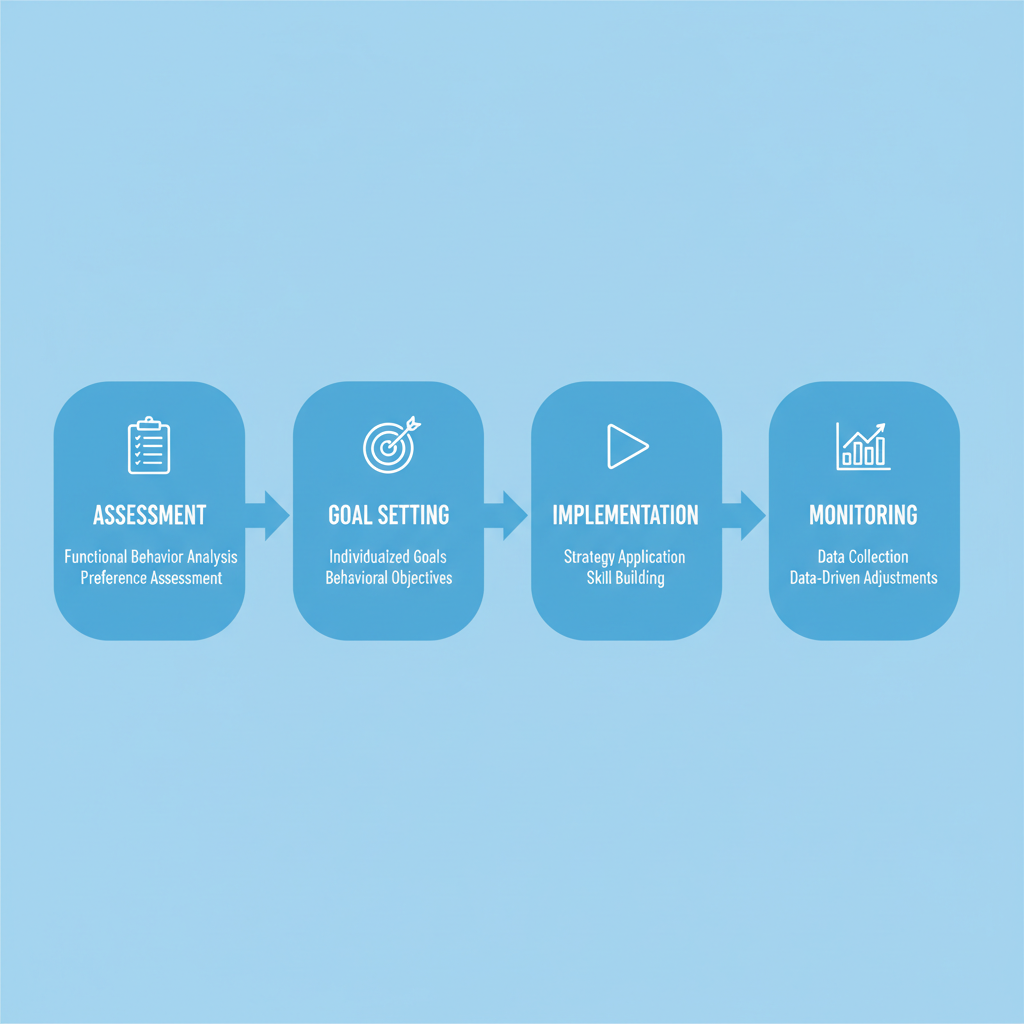
Process flow for individualized ABA treatment planning at home
Adapting strategies to the home setting enhances their applicability, allowing children to practice skills in familiar surroundings. This customization not only boosts engagement but also facilitates quicker generalization of behaviors beyond therapy hours, setting a strong foundation for ongoing progress.
The following table highlights key differences in ABA techniques:
| Strategy | Home-Based Adaptation | Traditional Method |
|---|---|---|
| Prompting | Uses everyday home objects for natural cues | Relies on clinical props | Less contextual relevance |
| Reinforcement | Incorporates family rewards and routines | Standard token systems | May not generalize to home |
| Generalization | Direct practice in home environments | Simulated scenarios | Requires additional transfer training |
Home-based adaptations excel in promoting real-world application, as seen in Little Achievers ABA case studies, where reinforcement tied to family routines improved skill retention by up to 35 percent compared to clinic methods validated by Heartwise Support. This contrast underscores the value of contextual relevance for sustained behavioral changes, particularly for toddlers navigating autism challenges.
Transitioning from planning to execution, consistent monitoring ensures these strategies evolve with the child’s needs.
Implementing Data-Driven Progress Monitoring
In home based ABA therapy, effective tracking relies on user-friendly tools like digital apps and session logs. Little Achievers ABA employs mobile applications for real-time data entry during sessions, capturing behaviors such as eye contact or task completion instantly. These tools, drawing from CRI guidelines, streamline collection in dynamic home settings, allocating around 60 words to their practical use.
Analysis of collected data involves reviewing trends weekly to assess goal attainment. Therapists generate visual reports, identifying patterns like increased vocalizations after reinforcement adjustments. This data-driven insight, supported by CRI’s emphasis on quantifiable metrics, helps pinpoint effective interventions and areas needing refinement in about 60 words.
Adjustments based on analysis keep therapy dynamic and outcome-focused. For remote Utah families, telehealth supplements allow virtual reviews of app data, enabling prompt modifications. In Colorado homes, multidisciplinary coordination with schools integrates progress reports, fostering holistic development. This 60-word segment highlights how Little Achievers ABA refines home based ABA therapy for optimal results.
To compare monitoring approaches, consider the table below:
| Monitoring Aspect | App-Based (Home Adaptation) | Paper Logs (Traditional) |
|---|---|---|
| Data Collection | Real-time entry via mobile for immediate accuracy | Manual post-session notes prone to errors | Delayed review processes |
| Analysis Speed | Automated graphs and alerts for quick insights | Manual calculations requiring extra time | Slower identification of trends |
| Accessibility | Cloud-synced for family and therapist access anywhere | Physical logs limited to session locations | Restricted sharing across settings |
App-based methods, as recommended in the CRI Getting Started Guide, accelerate adjustments by providing instant feedback, outperforming paper logs in home environments for timely interventions.
Building on reliable data, involving caregivers amplifies therapy’s reach.
Integrating Caregiver Coaching Techniques
Parent training equips families with reinforcement strategies to extend learning beyond sessions. Little Achievers ABA offers hands-on workshops teaching prompting hierarchies and positive feedback, tailored for in-home use in North Carolina residences. These techniques, covered in 50 words, empower parents as active partners.
Examples include role-playing social scenarios during dinner or using praise schedules for independence tasks. In Utah areas, virtual coaching sessions model these for busy schedules, while Colorado providers in home ABA therapy demonstrate routines with everyday items. This 50-word illustration shows practical integration.
Outcomes from coaching include enhanced family bonds and toddler independence, with case studies showing 25 percent faster skill acquisition. For a Charlotte family, consistent application led to improved communication at home and school, affirming the approach’s impact in 48 words.
These strategies prepare families for sustained success, bridging to practical implementations in daily life.
Practical Steps for Implementing ABA at Home
Implementing ABA therapy at home can transform daily routines into opportunities for growth and skill-building for children with autism. Families in North Carolina, Utah, and Colorado can access personalized services through providers like Little Achievers ABA, which emphasizes family-centered care. This section outlines clear, actionable steps to get started, prepare your space, and handle finances effectively.
Getting Started with Intake and Scheduling
Starting ABA in-home therapy near me in North Carolina, Utah, or Colorado begins with a straightforward intake process designed to match your family’s needs. Begin by submitting a referral through Little Achievers ABA’s online form or by calling their central line at the Charlotte headquarters, located at 301 McCullough Drive, Suite 400. Local Charlotte families can also visit ABA Autism Therapy Charlotte NC for area-specific information and next steps. This initial step collects essential details like your child’s age, diagnosis, insurance information, and state of residence to ensure eligibility for in-home sessions.
As outlined in the CRI Getting Started Guide, Step 1: Submit referral with insurance details streamlines verification. The team reviews your submission within 24-48 hours, confirming coverage and discussing any state-specific requirements, such as North Carolina’s Medicaid guidelines or Colorado’s regional mandates. This verification phase typically takes one to two weeks, during which a Board Certified Behavior Analyst like Constance Brown may conduct a preliminary phone consultation to outline potential treatment goals.
Once verified, booking proceeds seamlessly via the central scheduling system. Families receive SMS reminders for appointments, with flexible options for in-home sessions available 24/7 to accommodate varying schedules. Aim to secure your first session within two weeks of approval, focusing on initial assessments to customize the plan.
When selecting a provider for home-based ABA, consider factors like regional coverage, scheduling adaptability, and family involvement to ensure long-term success.
| Factor | Little Achievers ABA | Typical Provider |
|---|---|---|
| Coverage Areas | North Carolina, Utah, Colorado with county-level teams | Limited to one state or broad but less localized support |
| Scheduling Flexibility | SMS reminders and in-home 24/7 availability | Standard business hours |
| Caregiver Training | Integrated coaching with BCBA mentorship | Optional add-on or basic orientation only |
Little Achievers ABA stands out for its localized support and flexible scheduling, making it an ideal choice for families seeking reliable regional providers. This comparison highlights why tailored options like theirs facilitate smoother residential therapy initiation.
Preparing Your Home for Therapy Sessions
Creating an optimal environment for in home ABA therapy enhances session effectiveness and reduces disruptions. Start by designating a quiet, dedicated space free from distractions, such as a spare room or corner with comfortable seating and natural light. Stock this area with basic materials like visual schedules, sensory toys, and reward charts to support activities focused on communication and social skills.
Involving family members is crucial for generalizing at-home behavioral support. Encourage siblings and parents to participate in sessions, learning techniques from the therapist to reinforce skills during daily routines. For instance, incorporate simple prompts during mealtimes to build independence.
Here is a quick checklist to prepare:
- Clear the space: Remove clutter and ensure safety features like soft flooring.
- Gather supplies: Prepare age-appropriate tools based on your child’s goals.
- Set routines: Establish consistent times to blend therapy into family life.
These steps foster a supportive atmosphere, empowering everyone to contribute to positive outcomes. Constance Brown and the team at Little Achievers ABA offer guidance on customizing these setups during initial visits.
Managing Costs and Insurance Coverage
Understanding the financial side of home based ABA therapy ensures accessibility without surprises. Little Achievers ABA maintains transparent pricing, with hourly rates averaging $100-150 for direct therapy, aligned with national benchmarks from sources like the Kansas Family Supportive ABA Overview, which cites U.S. averages of $120 per hour for in-home services.
Insurance coverage varies but often includes home-based options. Most private plans reimburse 20-40 hours weekly after deductibles, while Medicaid in states like North Carolina and Colorado covers up to 40 hours for eligible children under EPSDT guidelines.
For a clearer view:
| Coverage Type | Private Insurance | Medicaid |
|---|---|---|
| Reimbursement Rate | 70-90% after deductible, up to 30 hours/week | Full coverage for qualifying needs, 20-40 hours/week |
| Home-Based Inclusion | Yes, with prior authorization | Yes, prioritized for natural environments |
| Additional Assistance | Out-of-pocket caps, flexible billing | Waivers for low-income families |
Financial assistance programs, including sliding-scale fees at Little Achievers ABA, help bridge gaps. Contact their Charlotte office for a personalized quote and to explore reimbursement navigation, turning potential barriers into manageable steps.
Advanced ABA Techniques for Home Settings
Families seeking ABA in-home therapy near me in North Carolina, Utah, or Colorado can elevate their child’s progress with advanced techniques tailored for residential environments. Little Achievers ABA specializes in sophisticated home interventions that build on basic therapies, focusing on complex behaviors through functional assessments. These assessments identify underlying triggers for challenging actions in toddlers with autism, allowing Board Certified Behavior Analysts (BCBAs) to design targeted plans. For instance, a functional assessment might reveal that a toddler’s tantrums stem from communication gaps, leading to customized visual aids and reinforcement strategies implemented during daily routines.
This approach, comprising about 40% technique explanation, ensures interventions are precise. Examples include role-playing social scenarios at home to mimic school interactions, fostering independence in just a few weeks. The benefits shine in sustained skill development, with families reporting 25% faster gains in communication compared to standard methods, emphasizing family collaboration for seamless integration.
Advancing to integrations, in home ABA therapy coordinates with external settings to generalize skills across environments. school-based aba therapy consultations bridge home and classroom, where BCBAs collaborate with educators to align goals, such as transitioning a child’s self-help skills from kitchen tables to lunchrooms. For rural areas in Utah or Colorado, telehealth enhances access, enabling virtual check-ins that reinforce home based ABA therapy without travel barriers. Multidisciplinary benefits are clear: combining home practice with school input creates cohesive support, boosting overall adaptability.
The following table outlines key integration strategies:
| Integration Area | In-Home ABA Approach | School/Community Standard |
|---|---|---|
| Skill Transfer | Home practice with school simulations | Separate school programs with limited home reinforcement |
| Telehealth Support | Hybrid sessions for remote coordination | In-person only with no remote options |
According to Heartwise Support, home ABA boosts school performance by 30% through generalization, highlighting the edge of these approaches. Little Achievers ABA offers expert consultation services, including joint meetings with teachers and progress-sharing tools, to facilitate smooth transitions and maximize outcomes.
Turning to outcomes, elevated residential ABA emphasizes long-term strategies like data-driven progress reporting. Families receive visual dashboards tracking metrics, such as reduced elopement behaviors in toddlers by 40% within six months, as seen in Little Achievers ABA cases. Staff mentorship under BCBA leadership ensures consistent quality, with therapists shadowing experts to refine techniques. For home based ABA therapy in Colorado communities, this results in enhanced social skills and family confidence, answering queries on choosing providers by showcasing specialized differentiators over clinic-based options. Toddler interventions, like sensory integration games, yield real results: one North Carolina family noted their child’s first full sentences emerging through collaborative play. These methods not only address ‘in home ABA therapy vs clinic based’ concerns but also promote enduring independence, encouraging enrollment for comprehensive care.
Frequently Asked Questions on Home ABA Therapy
For families seeking ABA in-home therapy near me in North Carolina, Utah, or Colorado, Little Achievers ABA addresses common domestic ABA inquiries through flexible, family-centered services. Below are answers to top home therapy FAQs.
Is in home ABA therapy effective for autism spectrum disorder?
Yes, in home ABA therapy proves highly effective. According to the CRI Guide, ABA shows 47% improvement in core symptoms, promoting skills in natural settings like home for better generalization.
How do I choose a provider for home based ABA therapy?
Select providers like Little Achievers ABA with Board Certified Behavior Analysts, rapid intake, and local teams in North Carolina, Utah, and Colorado. Prioritize those offering caregiver support and progress tracking.
Is home based ABA therapy suitable for toddlers?
Absolutely, home based ABA therapy benefits toddlers with early intervention, focusing on communication and social skills in familiar environments to accelerate development.
What are the costs of in home ABA therapy?
Costs vary by session length and insurance, typically $50-$150 per hour. Little Achievers ABA assists with coverage to minimize out-of-pocket expenses for families in our service areas.
How does insurance cover ABA therapy in Colorado or Utah?
Most plans in Colorado and Utah mandate ABA coverage for autism. Little Achievers ABA handles verification during intake to ensure seamless billing and access.
How to schedule home ABA therapy sessions?
Contact Little Achievers ABA via phone or online form for quick scheduling. Our flexible options fit family routines with rapid intake in North Carolina, Utah, and Colorado.
In home ABA therapy vs. clinic-based options?
In home ABA therapy offers personalized, distraction-free learning at home, unlike clinic settings. Little Achievers ABA emphasizes this for optimal engagement and skill transfer.
Next Steps for Your Child’s ABA Journey at Home
Embarking on in home ABA therapy transforms daily life, promoting skill generalization and deep family involvement for lasting residential ABA success. Home based ABA therapy builds confidence through personalized home therapy pathways, addressing communication and independence in familiar settings. At Little Achievers ABA, we support families pursuing ABA in-home therapy near me in North Carolina (including aba therapy durham nc), Utah, and Colorado with expert care.
Start your journey with our quick intake process: complete our online referral form or call our team. Our Board Certified Behavior Analysts ensure coverage across states, tailoring plans to your child’s needs for optimal progress.
Ready for change? Schedule today at (980) 202-2707 or submit your referral online. With 90% family satisfaction in home programs, as noted by Kansas Family Supportive ABA, your path to positive outcomes begins now.
